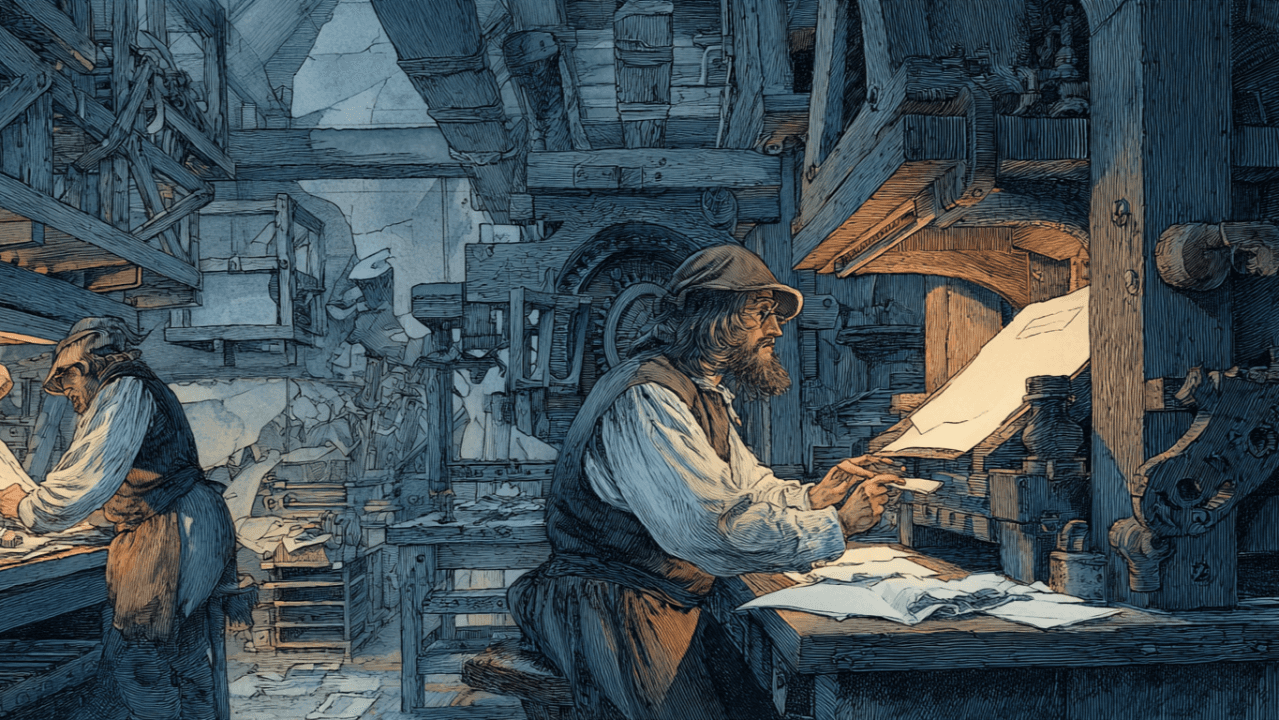
AI is doing to software what the printing press did to scribes. Creation is becoming cheap, fast, and accessible to everyone. The challenge isn’t building products anymore—it’s making ones that aren’t bland, copyable, or forgettable.
At a recent family gathering, I was having one of my usual conversations about AI with the (always fascinating) Matthew Rance. We started talking about the latest AI developments (GPT-5 has just dropped, naturally) but ended up diving deep into the fundamental shifts happening in technology. The conversation took an unexpected turn when he presented an analogy that stopped me in my tracks.
"Think about it," he said, "what we're seeing with AI and coding is basically the printing press all over again."Lightbulb moment!
Picture this: it's 1440, and you're a scribe living in Mainz, Germany. You've spent years perfecting your penmanship, mastering Latin, and building a reputation as one of the finest manuscript copyists in the region. You've got job security that would make a modern creative director weep with envy – after all, books don't copy themselves, right?
Then some bloke named Gutenberg shows up with his fancy metal letters and printing contraption, and suddenly your entire profession becomes about as relevant as a fax machine in 2025.
Fast-forward 585 years, and I can't help but wonder if we're witnessing a remarkably similar moment. Except this time, it's not just scribes getting disrupted – it's the entire way we think about creating digital products. The printing press? It's called GPT-5, Claude, Copilot, or whatever AI assistant is making headlines this week.
The scribes had it coming (and so might we)
Before 1440, books were precious, rare things. Creating a single copy required a scribe to spend months painstakingly copying every letter by hand. It was skilled work – these weren't average medieval peasants with quills. Scribes were educated, multilingual, and possessed the steady hands of todays surgeons.But this process was ridiculously inefficient. A single scribe might produce four or five books in their entire career. Books were so expensive that only the wealthy elite could afford them, meaning knowledge was hoarded by a tiny fraction of society.
The printing press changed everything almost overnight. Suddenly, a single machine could produce hundreds of copies in the time it took a scribe to complete one. The cost plummeted, literacy rates soared, and knowledge spread like wildfire across Europe. The Renaissance, the Scientific Revolution, the Protestant Reformation – they all owe a debt to those little metal letters.
The scribes? They largely found themselves out of work. Some adapted, becoming editors or type-setters, but the profession as it had existed for centuries was extinct within a generation.
See where I'm going with this?
The modern scribes of Silicon Valley
Fast forward to digital product creation in 2025. Whether you're building a mobile app or complex software platform, the process is still fundamentally manual and artisanal, requiring a small army of specialists.You need designers to understand user needs and craft experiences. Developers to turn designs into functional code. Product managers to coordinate the chaos. QA testers to ensure everything works. DevOps engineers to deploy it all. Each role requires years of specialised training.
Building digital products is expensive, time-consuming, and requires technical expertise that excludes most people from participating as creators rather than consumers. Got a brilliant idea? You'll need to either learn multiple complex disciplines, hire an expensive team, or convince investors to fund your vision.
Just like books in 1440, digital creation is the domain of a skilled elite. And like those medieval scribes, we've gotten comfortable as the gatekeepers of digital innovation.
I've spent years trying to master design systems, user psychology, product documentation, and learning just enough code to be dangerous. It's been rewarding work, but even with this knowledge, turning ideas into reality still feels like climbing a mountain while carrying rocks.
The AI printing press arrives
But then Large Language Models showed up, and suddenly my carefully crafted workflows started looking... quaint.A tweet by Sam Altman the CEO of OpenAI on 3rd August 2025, with 3 million views and 1600 replies. It reads "entering the fast fashion era of SaaS very soon"
Sam Altman believes that soon, people will be able to create their own highly targeted SaaS products.
I remember the first time I managed to vibe-code a working application through context engineering with Cursor. I didn't write traditional code – I described what I wanted, refined my prompts, and ended up with clean, functional code that actually worked. It felt like magic, and slightly like cheating. It was a simple flappy bird clone, but it worked and was completed in an hour.
My initial reaction was what I imagine a scribe felt watching Gutenberg's first printed page: "Well, that's both impressive and mildly terrifying."
Through daily experimentation, I'm discovering AI can:
- Generate entire user interfaces from descriptions
- Write functional code following best practices
- Create design systems and component libraries
- Build responsive layouts across devices
- Implement complex interactions and animations
The great democratisation of digital creation
Here's where the printing press analogy really resonates. Just as Gutenberg democratised knowledge by making books accessible, LLMs are democratising digital creation by making it accessible to anyone who can articulate their needs.Imagine a world where:
A restaurant owner creates a custom reservation system by describing their workflow
A teacher builds an interactive learning platform tailored to their curriculum
A charity develops a donor management system that fits their operations perfectly
This isn't science fiction – it's happening now. I've been experimenting with having AI generate entire product prototypes from user story descriptions. The gap between "I have an idea" and "I have a working prototype" is shrinking at breakneck speed.
You don't need to be a proper developer to participate. You just need to learn context engineering, application structure basics, and crucially – security considerations.
The great homogenisation problem
Let's address the elephant that's been bothering me: what if we're heading towards a beige, templated hellscape where every digital product looks like it was churned out by the same AI factory?
When I'm vibe-coding through projects, I've noticed something unnerving: AI tends to reach for the same patterns, components, and colour schemes. Ask for a dashboard and you'll get that same clean, minimal layout with cards and charts. Request a landing page and hello hero section with centred text, three feature cards, and a probably-blue CTA button.
It's like we're all shopping at the same digital IKEA, assembling the same flat-pack interfaces with slightly different colours.
AI doesn't do weird. It doesn't wake up thinking "Let's put the navigation at the bottom just to see what happens." It optimises for what it's seen work before – the average, expected, and safe.
Remember when websites didn't all look like Bootstrap templates? When designers created interfaces that made you go "What the hell is this?" before realising it was brilliant? AI doesn't have weird ideas. It has statistically probable ideas.
The more we lean on AI, the more we risk creating a digital monoculture where everything works efficiently but nothing surprises or delights. We might solve more problems, but will we solve them in interesting ways?
The defensibility dilemma
If everyone can spin up a SaaS product over a weekend using AI, what happens to competitive advantage? What stops our carefully crafted solution from being cloned faster than you can say "product-market fit"?I've been actively playing this out myself. Prior to my current role, I owned a company whose product was a video game database – building it cost £400,000 and took 13 months. In four evenings (16 hours), I managed to build the beginning of the project solo: database schema, data import, landing page, authentication, game pages, user profiles, reviews, and favourites.
Side-by-side comparison of two gaming database interfaces. Left: "We the Players" website showing Agent.48's profile with dark blue styling, featuring 128 games, 21 reviews, and game thumbnails including A Hat in Time, Apex Legends, and Assassin's Creed Odyssey, with sections for currently playing games and reviews. Right: "VGDB Games Database" showing Token's profile with dark grey styling, displaying favourite games in a grid layout including Golden Axe, Paper Mario, and Street Fighter V, plus gaming statistics showing 744 hours total playtime and follower counts.
The tale of two databases: On the left, the development team built version that cost £400k and 13 months. On the right, the AI assisted rebuild accomplished in just 16 hours (4 x 4 hour evening sessions).
It's insane.
So where does that leave those trying to build actual businesses rather than cool demos? After raising the question of defensibility with Nord Samuelson and having a session discussing it, the answer seems to lie in everything AI can't replicate – at least not yet.
Data network effects: Your product might be clonable, but your data isn't. If you're building something that gets smarter with every user interaction, that's your defensibility.
Community and ecosystem: You can clone Figma's features, but not the thousands of plugins, community templates, shared knowledge base, and muscle memory of millions of designers.
Domain expertise baked in: AI can help anyone build a CRM, but can it build one for clinical trials that understands subject transactions and randomisation lists? The more specific your domain knowledge, the harder to replicate.
The trust factor: When choosing important software, I'm buying reliability, support, and confidence they'll be around next year, not just features.
Maybe defensibility isn't about preventing copies, but not caring about them. If you can use AI to build and iterate so quickly that you're always experimenting, always trying new things – maybe that's the real competitive advantage. .It's like that old saying about outrunning a bear – you don't need to be faster than the bear, just faster than the other hikers. In the AI age, you don't need to be uncopyable, just unpredictable.
Evolving our craft
What happens to those who've built careers on being the bridge between ideas and implementation?I don't think we become obsolete – we become something more interesting. Instead of creating mockups and specifications, we become:
Experience architects: Focusing on high-level user journeys and emotional arcs rather than pixel-perfect layouts
AI collaborators: Learning to work with AI tools as creative partners, knowing how to prompt effectively and when to push back
Quality guardians: Ensuring AI-generated solutions actually solve real user problems and meet accessibility standards
Innovation catalysts: Using our understanding of user needs and technical possibilities to identify opportunities others might miss
The role becomes more strategic, more human-centred, and frankly, more creative. Let AI handle routine implementation – I'd rather think about solving problems that improve people's lives.
The Gutenberg moment for product creation
We're living through a genuine Gutenberg moment – one of those rare inflection points where technology doesn't just improve existing processes but fundamentally changes what's possible.
The printing press didn't just make books cheaper; it made new kinds of books possible. Scientific journals, newspapers, novels, instruction manuals – entire categories that couldn't exist in a hand-copying world.
Similarly, AI-powered development won't just make existing software cheaper; it will make entirely new categories of digital solutions possible. Hyper-personalised applications, truly bespoke business tools, experimental interfaces that would never be economically viable with traditional development.
We're moving towards a world where digital solutions become as malleable and personal as language itself. Where the gap between identifying a problem and creating a solution shrinks to nearly nothing. Where anyone with deep domain understanding can create tools that serve that domain perfectly.
The future is collaborative
The scribes may have lost their jobs, but the world gained something far more valuable: the ability for anyone with something to say to say it in print.Now we're on the verge of giving anyone with a problem the tools to solve it digitally.
As someone passionate about creating meaningful user experiences whilst fumbling through AI-assisted development, that sounds like a pretty good trade. The question isn't whether this revolution is coming – it's whether we'll be thoughtful about how we shape it.
Let's make sure that as we democratise digital creation, we don't lose sight of what makes great products great: deep empathy for users, attention to accessibility and inclusion, and understanding that technology should serve human needs, not the other way around.
And if you're like me, learning as you go? Welcome to the club 👋. We're all figuring this out together, and that's rather exciting.